As the Content Design Lead on a major transformation initiative, I developed a set of content design and UX writing standards to support 8 product teams—many without dedicated content designers. These standards enabled clarity, consistency, and accessibility across a high-stakes, multi-product service used by approximately 1 million people each year.
Project details
- As part of a large federal digital transformation initiative, several new digital products were being developed simultaneously for a complex, high-stakes service.
- There were no shared content guidelines beyond the high-level Canada.ca Content Style Guide, creating risk for inconsistency, inaccessibility, and inefficiency.
- The environment was fast-paced, complex, and resource-constrained. Some teams lacked dedicated content designers and relied on UX designers to write content.
Note some details have been anonymized or redacted.
The challenge
- Enable consistency, clarity, and accessibility across multiple digital service teams, many without embedded content support.
- Existing content guidelines were scattered or non-existent; a previous attempt to audit and unify them had failed.
- Product teams were under pressure to deliver quickly, often working without dedicated content designers.
- Reduce duplication and confusion by providing a single source of truth for content decisions.
- Teams needed practical, easy-to-use standards that could guide both content and product designers across multiple teams and service areas.
My role
As the Content Design Operations Lead within the DesignOps team, I was responsible for:
- Leading the creation of content design and UX writing standards.
- Consulting with cross-functional teams to understand user needs, delivery goals, and real-world challenges.
- Developing reusable patterns, templates, and guidance that addressed both microcopy and broader service content.
- Writing all documentation and templates, grounding them in plain language, accessibility, and usability best practices to ensure adoption by content and non-content specialists.
- Socializing the standards through training sessions, 1:1 support, and hands-on reviews.
- Iterating the guidance based on continuous feedback and evolving product needs.
Approach
I applied a systems-thinking lens to ensure the standards were:
- Scalable across teams and products.
- Grounded in real-world needs, informed by consultations with product owners, researchers, product designers,
- Modular and reusable, with templates and patterns for microcopy, error messages, etc.
Key methods included:
- Content audits and gap analyses.
- Co-design workshops with cross-functional teams.
- Iterative feedback loops to refine guidance based on evolving needs.
Team alignment and influence
To ensure adoption and alignment:
- I socialized the standards through training sessions, 1:1 support, and hands-on reviews.
- I worked closely with teams to embed the guidance into their delivery processes.
- I helped raise the profile of content design within the organization, advocating for its role in product success.
Outcomes
- A living set of scalable content design standards tailored to the client’s digital transformation goals.
- Enabled more consistent, inclusive, and user-centered content across multiple products and teams.
- A better user experience, with reduced emotional and cognitive load through accessible, empathetic design.
- Reduced the burden on designers working without dedicated content support.
- Improved collaboration between content designers, UX designers, and product managers.
- Helped raise the profile of content design as a critical part of product development within the organization.
Tools and methods
- Systems thinking and design operations
- UX writing and content design principles, including the project's experience and design principles
- Accessibility and inclusive content best practices (e.g., WCAG, plain language)
- Content audits and gap analysis
- Co-design and collaborative workshops
- Iterative feedback loops and user-centered design cycles
- Figma, ADO, Miro, M365
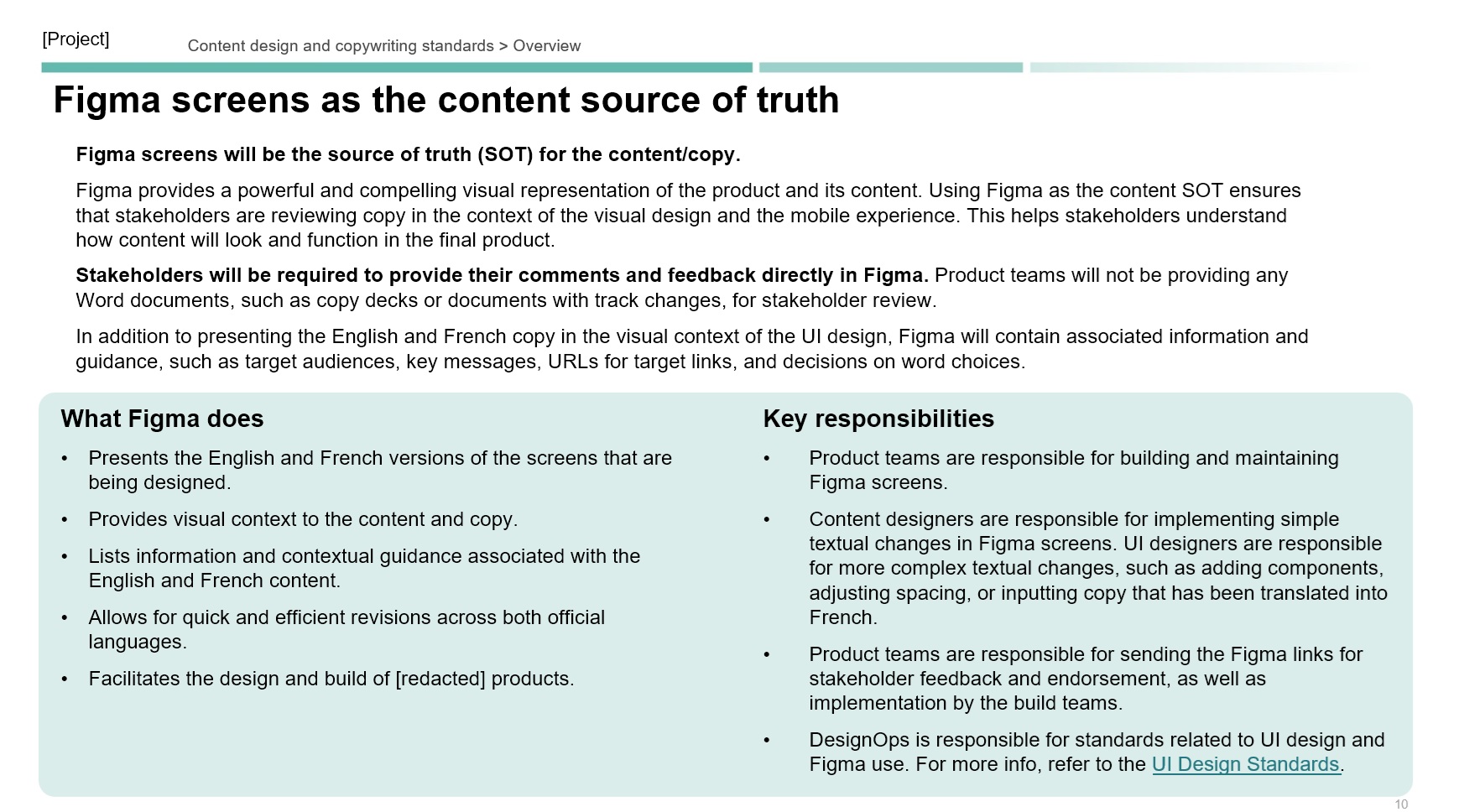
This slide from the content standards deck explains how Figma would serve as the source of truth for bilingual content during the product design phase.
The slide outlines what Figma enables, clarifies team responsibilities, and reinforces how visual context supports clarity and consistency across English and French content.
This guidance was especially important because many client team members were new to Figma and initially hesitant to use it. By clearly defining its role and providing structured support, we helped teams adopt the tool and integrate it into their workflows.