As part of a company-wide branding refresh, I led the creation of Systemscope’s first voice and tone guide. Through collaborative workshops and plain-language best practices, I delivered a clear, actionable guide that helps all employees communicate with clarity, consistency, and confidence.
Project details
- As part of a larger branding refresh, Systemscope identified a gap: there was no consistent brand voice guiding how the company communicated with clients, stakeholders, or the public.
- Communications varied from team to team, and feedback from both internal and external sources highlighted a lack of consistency and polish.
- A voice and tone guide was needed to reflect the firm’s professionalism and align with the values of its primary client, the Government of Canada.
The challenge
- Communications across teams lacked a unified voice, leading to inconsistencies in how the firm presented itself.
- Employees needed clear, practical guidance they could easily apply, regardless of their writing experience or role.
- The guide had to strike a balance: authoritative but approachable, confident but not overly formal.
- We needed a participatory, human-centered process to ensure the guide was useful and adopted by the whole company.
My role
- Led the development of the voice and tone guide from research to delivery.
- Researched best-in-class voice and tone guides and incorporated findings from a market research survey.
- Facilitated collaborative workshops on Miro with staff from across the company, including:
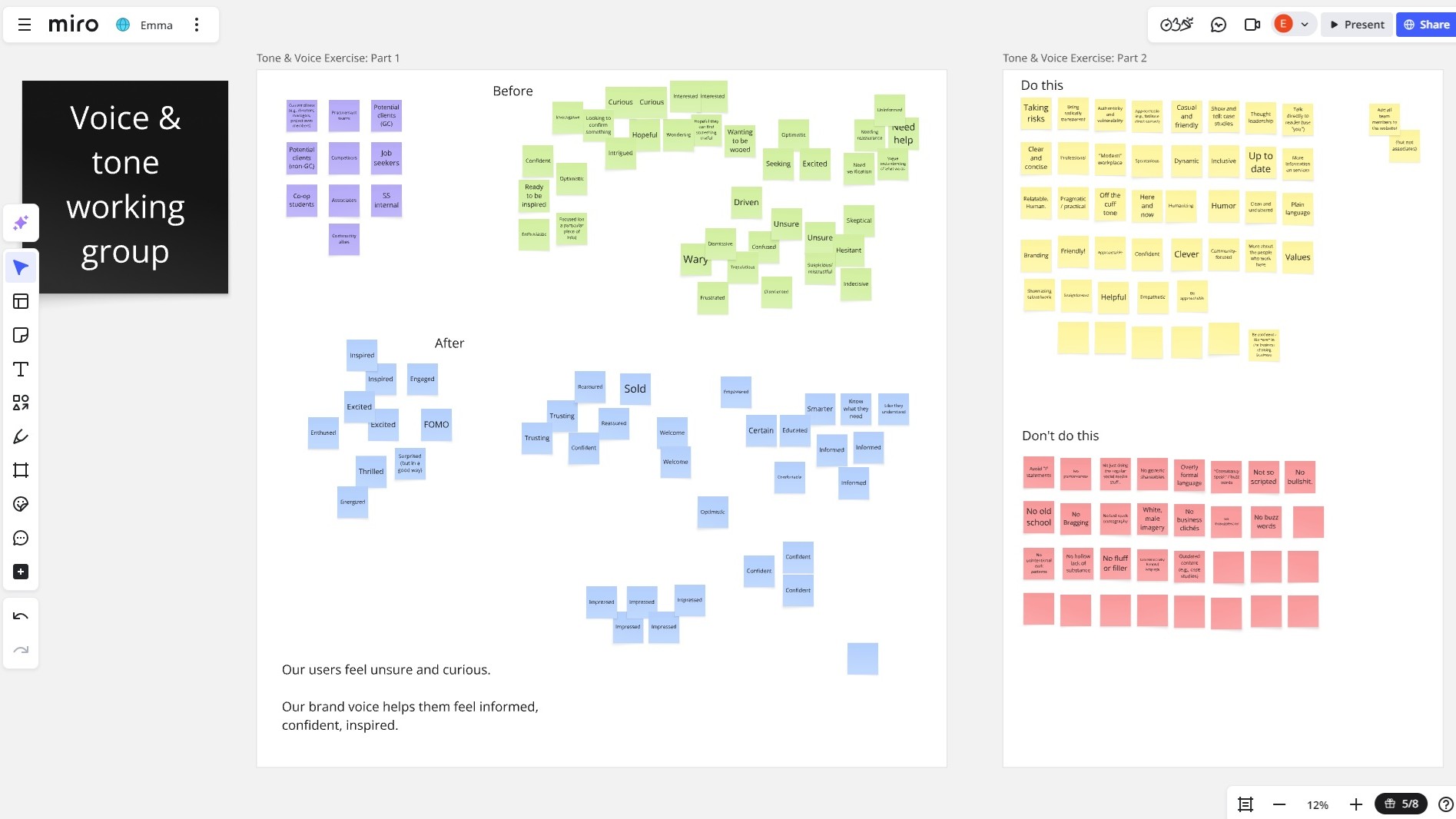
- Audience mapping and “before/after” tone exercises to define how users feel and how we want them to feel.
- “Do this / Don’t do this” exercises to surface examples of good and poor tone.
- Dot voting to co-create three defining voice attributes for our brand.
- Synthesized results into clear guiding statements: Our users feel unsure and curious. Our brand voice will help them feel informed, confident, and inspired.
- Created a plain-language word list (e.g., use “find out” instead of “ascertain”) to help writers across the company avoid jargon.
- Wrote and iterated the guide based on feedback from internal teams and the executive leadership.
- Presented the guide company-wide and integrated it into onboarding and daily practice.
Approach
I used a human-centered, collaborative approach to ensure the guide reflected the company’s culture and was easy to adopt:
- Facilitated co-design workshops to define tone and voice attributes.
- Used plain language principles to make the guide accessible to all employees.
- Incorporated feedback loops and iterative testing to refine the guide.
- Aligned the voice with both internal values and external expectations, especially those of public sector clients.
Team alignment and influence
- Engaged staff across departments in defining the brand voice, ensuring buy-in and relevance.
- Integrated the guide into onboarding and daily workflows to support long-term adoption.
- Increased confidence among non-writers in applying the brand voice consistently.
- Helped unify the company’s external communications and strengthen its brand identity.
Outcomes
- Delivered a practical, plain-language voice and tone guide tailored to Systemscope’s culture, audience, and work.
- Received positive feedback from staff and clients about the improved clarity, consistency, and professionalism in our communications.
- Increased confidence among non-writers in applying the brand voice.
- The guide is now a foundational part of our onboarding materials and brand standards.
Explore Systemscope's voice and tone guide.
Tools and methods
- Voice and tone research and competitive analysis
- Human-centered design workshops
- Plain language editing and terminology guides
- Collaborative synthesis and co-design
- Internal presentations and feedback loops
- Miro, M365
This screenshot captures a collaborative Miro board used during a voice and tone working session with key stakeholders.
The exercise helped surface how users feel before interacting with the company, how we want them to feel afterward, and the voice and tone principles that would support that shift. It also clarified what to do and what to avoid.
This session laid the groundwork for the content principles and examples included in the final voice and tone guide.